If you have looked at your Google Analytics 4 (GA4) dashboard recently, you might have felt a knot in your stomach.
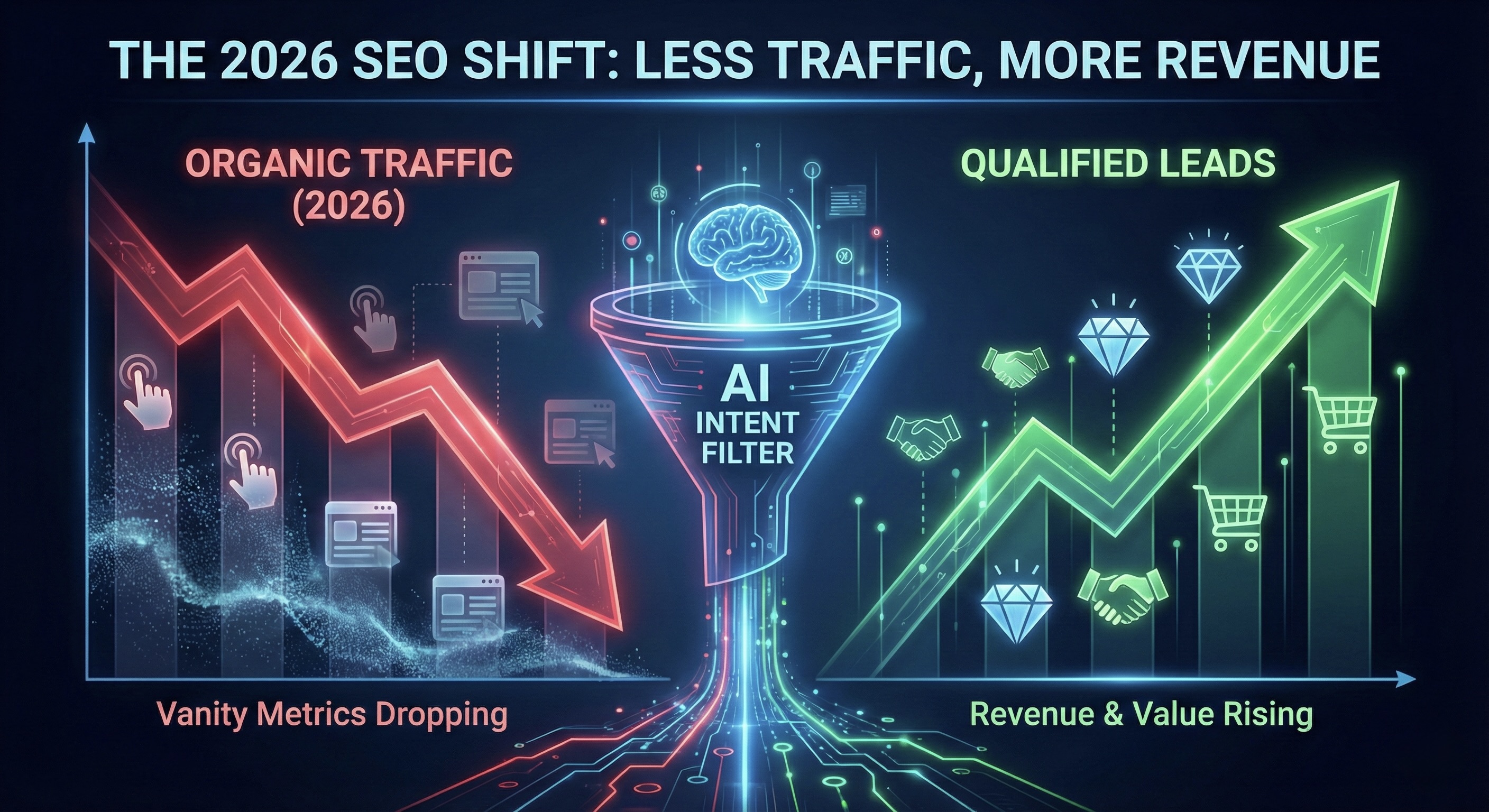
For many businesses, the "Total Sessions" line is trending downward. In 2023 or 2024, a drop like this would have been a five-alarm fire. It would mean you were penalized, or your competitors were eating your lunch. But in 2026, something strange is happening. Traffic is down 30%. But revenue is up 10%.
Welcome to the "Zero-Click" Era. The game hasn't ended, but the rules have completely changed. Google is no longer just a search engine that sends people to your website; it is an Answer Engine that keeps them on the results page. If you are panicking about traffic loss, stop. You aren't necessarily losing. You are just being filtered. Here is why this shift is actually good for your bottom line—and how to adapt your strategy to match.
1. The Death of "Vanity Traffic"
For a decade, SEO strategy was simple: "Write a blog about everything." We wrote definitions, simple "how-to" guides, and generic listicles. We celebrated when 10,000 people visited our site to read "What is a CRM?"
In 2026, that traffic is gone.
Google’s AI Overviews (AIO) now answer those simple questions directly at the top of the search results.
-
User Query: "Best time to post on Instagram"
-
Old Result: User clicks your blog, scrolls for 3 seconds, finds the answer, and leaves. (1 Session, 100% Bounce Rate, $0 Revenue).
-
2026 Result: Google’s AI summarizes the answer instantly. The user never clicks.
The Reality Check: You lost 10,000 visitors, but you didn't lose 10,000 customers. You lost 10,000 "window shoppers" who were never going to buy from you anyway.
2. The "Intent Filter": Why Leads Are Up
So, if the AI is stealing the easy traffic, who is left?
The Buyers.
The people who click through to your website in 2026 are the ones who weren't satisfied with a 50-word AI summary. They are looking for:
-
Deep expertise.
-
Human nuance and opinion.
-
Complex problem solving.
-
A specific product or service.
Google has effectively become a massive filter. It keeps the "informational" users on Google, and sends the "transactional" users to you.
Your traffic is lower, but it is purer. A visitor landing on your site today is 5x more likely to convert than a visitor from three years ago because they have already bypassed the basic information stage.
3. Adapting Your Strategy: From "Volume" to "Value"
If you continue to report on "Total Sessions" in your board meetings, you will get fired. You need to change the metrics you worship.
A. Stop Measuring Clicks, Start Measuring "Share of Model"
In the Answer Engine era, you might not get the click, but you must be the Source. When Google’s AI gives an answer, it cites sources. Your goal is to be cited. This builds immense brand trust ("Brand Salience"). Even if they don't click today, they remember you as the authority.
Action: Structure your content for AI extraction. Use clear data tables, direct answers in the first sentence of paragraphs, and schema markup.
B. Pivot Content to "Experience" (The New Moat)
AI can summarize facts, but it cannot summarize experience.
-
Dead Content: "10 Tips for Google Ads." (AI can generate this in 4 seconds).
-
Alive Content: "How We Reduced a Client's CPA by 40% using Negative Keywords." (AI cannot fake this).
Strategy: Every piece of content you publish in 2026 must have a "human fingerprint." Use case studies, personal opinions, contrarian views, and proprietary data.
C. The Rise of "Middle of Funnel" (MOFU)
Top-of-funnel (TOFU) traffic belongs to Google now. Bottom-of-funnel (BOFU) is expensive. The sweet spot for SEO in 2026 is the Middle of the Funnel.
-
Comparison content: "Ads Kong vs. Traditional Agencies"
-
Technical deep dives: "Advanced Server-Side Tracking for eCommerce"
These queries are too complex for a simple AI summary, forcing the user to click.
Case Study: The B2B Software Shift
Client: A Project Management SaaS Company. The "Crisis": In Q1 2026, their organic traffic dropped by 40% after a Google Core Update expanded AI Overviews. The Panic: The marketing team was terrified. They thought their SEO agency had failed.
The Audit: We dug into the data.
-
Lost Keywords: "What is project management," "Definition of Gantt Chart." (Low value, educational).
-
Retained Keywords: "Best enterprise project management software for remote teams." (High value, transactional).
The Result: Despite the 40% traffic drop, their Demo Requests increased by 15% month-over-month. Their server costs actually went down because they weren't serving pages to bots and students. They were making more money with less traffic.
Key Takeaways: The New 2026 KPI Dashboard
If you want to survive 2026, tear up your old reporting sheet. Here is what matters now:
-
Conversion Rate (CVR): This should be climbing. If traffic drops and CVR stays flat, then you have a problem.
-
Engagement Time: Are the few people who visit staying longer? (Target: >2 minutes).
-
Brand Mentions: Are you being cited in AI answers and industry news?
-
Qualified Leads: The only number you can take to the bank.
Conclusion: Don't Mourn the Traffic, Celebrate the Efficiency
The "Gold Rush" of easy SEO traffic is over. We are now in the "Diamond Mining" phase. It is harder work, the volume is lower, but what you find is infinitely more valuable.
Don't let a red arrow on a traffic chart distract you from the green arrow on your revenue chart.
Is your SEO strategy stuck in 2024? If you are still chasing vanity metrics and writing generic content, you are fighting a losing battle against the machines.
At Ads Kong, we specialize in AEO (Answer Engine Optimization) and high-intent SEO strategies that prioritize revenue over clicks. We help you navigate the shift so you come out smaller, maybe, but much, much more profitable.
Click here to request a 2026 SEO Strategy Audit at AdsKong.com