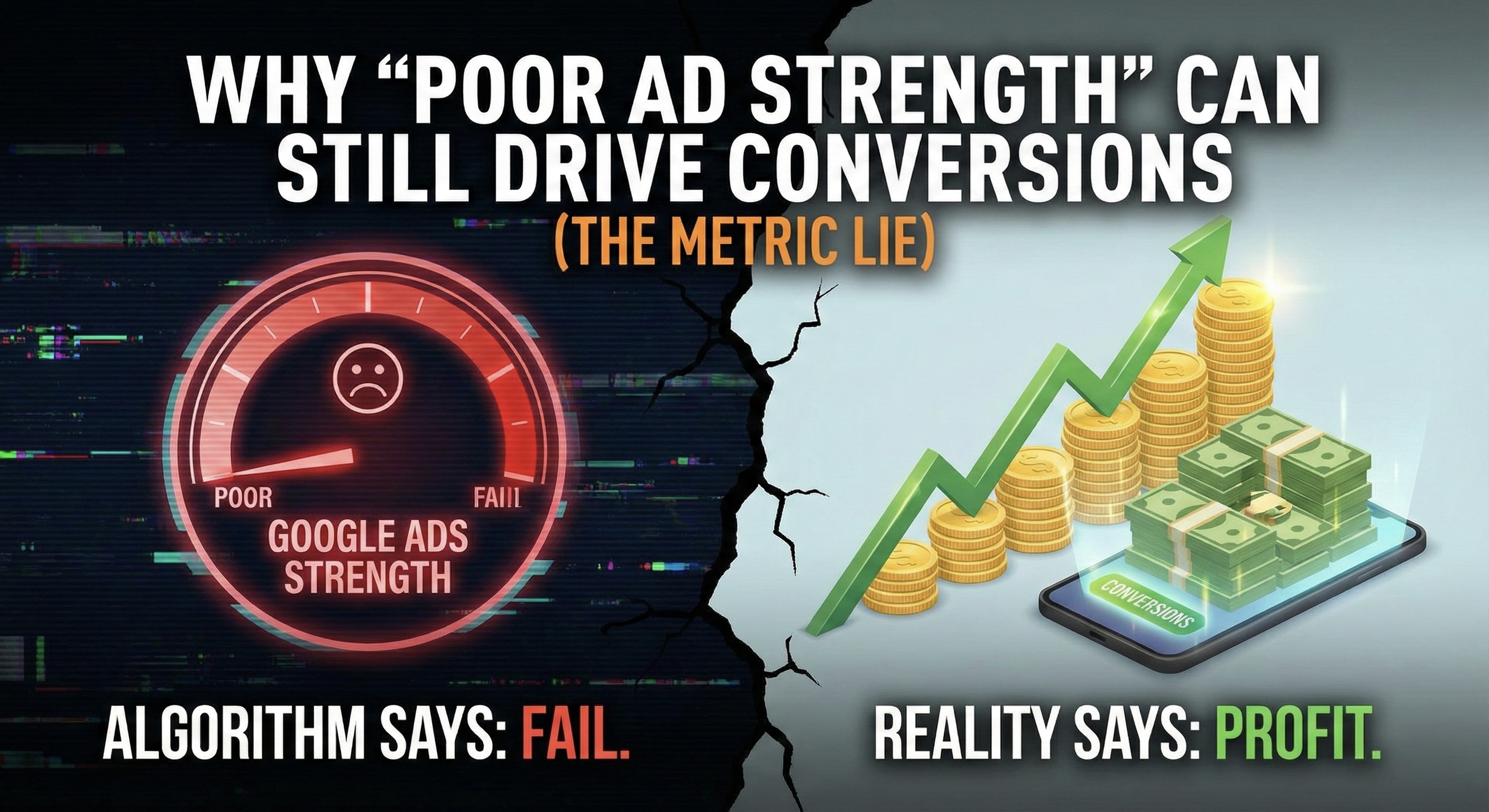
It is the notification that haunts every Google Ads manager.
You spend hours crafting the perfect headline. You write a copy that speaks directly to your customer's pain points. You launch the campaign, feeling confident.
And then, Google slaps you with it: "Ad Strength: Poor."
Panic sets in. You scramble to change the headlines, stuffing in more keywords just to turn that red "Poor" into a blue "Excellent." But here is the dirty secret that Google doesn't highlight in their dashboard:
Ad Strength is a technical metric, not a performance metric.
In 2025, we will see countless accounts where "Poor" ads are generating millions in revenue, while "Excellent" ads are burning the budget with zero conversions. If you are blindly optimizing for Ad Strength, you might be optimizing your way out of profit.
Here is why "Poor" Ad Strength can still be a winner, and why you often need to ignore the algorithm to please the human.
The Misunderstanding: What Ad Strength Actually Measures
To understand why the score is often wrong, you have to understand what it calculates.
Google’s "Ad Strength" score does not measure:
How persuasive your text is.
How likely a human is to click.
Your actual conversion rate.
Instead, it measures Machine Learning potential. It calculates two main things:
Relevance: Did you put the exact keyword in the headline?
Variety: Did you provide 15 distinct headlines so Google’s AI can mix and match them into thousands of combinations?
Google wants you to have an "Excellent" score because it gives their AI more ingredients to cook with. But just because you have more ingredients doesn't mean the meal tastes better.
The "Franken-Ad" Problem
When you chase an "Excellent" score, Google forces you to provide 15 different headlines. The algorithm then randomly stitches these together to show to users.
The problem? Cohesion.
If you are trying to write a specific, powerful message, randomizing it destroys the impact.
Example: The Luxury Watch Brand
Human Strategy: You want to say: "Handcrafted in Switzerland. The Last Watch You’ll Ever Buy." (This is emotional, singular, and powerful).
Google’s "Excellent" Demand: Google asks you to add 13 more headlines like "Buy Watches," "Best Prices," "Order Now," "Shop Online."
The Result: A user sees an ad that says: "Buy Watches | Shop Online | Best Prices"
Technically, this is an "Excellent" ad because it has variety. But emotionally? It’s generic garbage. It looks like every other ad on the internet.
A "Poor" ad that delivers a single, sharp, consistent message often outperforms an "Excellent" ad that reads like a robot wrote it.
Real Data: Ad Strength vs. ROAS
At Ads Kong, we analyzed data across multiple high-spend accounts in late 2025. The correlation between "Ad Strength" and "ROAS" (Return on Ad Spend) was near zero.
Ad A (Excellent Strength): High Impression share, but low Click-Through Rate (CTR). Why? It was generic.
Ad B (Poor Strength): Lower Impression share, but 2x Conversion Rate. Why? The copy was "pinned" to ensure the message was perfect, which Google hates (it lowers your score) but humans love.
The Lesson: Ad Strength measures how much Google likes your ad setup. Conversion Rate measures how much people like your offer. Always choose people.
When You Should Ignore "Poor" Strength
You should feel comfortable ignoring the "Poor" warning in these three scenarios:
1. You Are Using "Pinned" Assets
If you have a strict brand message (e.g., a legal disclaimer or a specific promotion that must be in Headline 1), you need to "pin" that headline. Google will instantly penalize your Ad Strength score for this because it restricts their AI. Ignore it. Control is more important than their score.
2. You Are in a Niche B2B Industry
If you sell "Enterprise Cloud Security for Healthcare," you don't have 15 different ways to say that. You have one specific way. Adding fluff just to please the tool will attract the wrong clicks.
3. Your Quality Score is High
Check your Quality Score (QS). This is the metric that actually affects your Cost Per Click. If your Quality Score is 8/10 or higher, but your Ad Strength is "Poor," you are fine. The "Poor" label is just a UI nudge, not a financial penalty.
When "Poor" Actually Means "Fix It"
There are times when "Poor" is a valid warning. You should pay attention if:
Your CTR is low (below 1%): If people aren't clicking, your copy might actually be boring. In this case, "Poor" is right.
You aren't using all asset types: If you have zero descriptions or no sitelinks, fix that. That is just laziness.
Your Impression Share is tanking: Sometimes, Google will refuse to show a "Poor" ad in certain auctions. If your ad is barely getting impressions, you may need to compromise and add a few more variations to get the machine running again.
The 2025 Strategy: The "Pinned" Hybrid
So, how do you balance the algorithm's need for variety with the human need for clarity?
The Strategy:
Pin Headline 1: Make this your "Hook." (e.g., "The Only SEO Tool You Need"). Pin it to position 1.
Pin Headline 2: Make this your "Value Prop." (e.g., "Get #1 Rankings in 30 Days"). Pin it to position 2.
Leave Headline 3 Unpinned: Give Google 5-6 variations for the third spot (e.g., "Free Trial," "Sign Up," "Learn More").
This gives you the structure you need for conversion, while giving Google just enough freedom to optimize the final CTA. Your Ad Strength might still say "Average," but your bank account will say "Excellent."
Conclusion: Trust Your Bank Account, Not the Dashboard
Google’s goal is to automate everything. Your goal is to make money. Sometimes these goals align, and sometimes they don't.
Do not be bullied by a red text warning in your dashboard. If your "Poor" ad is bringing in leads at a cost you can afford, do not touch it.
In the world of PPC, the only score that matters is on the scoreboard.
Are you tired of fighting the algorithm? At Ads Kong, we prioritize profit over vanity metrics. Let us audit your account and tell you which "Poor" ads are actually your goldmines.