For decades, the business world operated on a simple, brutal truth: He with the biggest budget wins.
Large corporations dominated because they could afford armies of data scientists, 24/7 customer support teams, and million-dollar ad campaigns. Small businesses were left fighting for scraps, relying on word-of-mouth and sheer hustle.
In 2025, that narrative has collapsed.
Artificial Intelligence has not just leveled the playing field; it has tilted it in favor of the agile. Today, a team of five using the right AI stack can out-maneuver a corporation of 500. Why? Because while big brands are stuck in weeks of legal compliance and red tape to approve a single tweet, small businesses are using AI to test, iterate, and deploy campaigns in minutes.
The question is no longer “Can small businesses compete?” The question is: “Are you brave enough to use the tools that make you dangerous?”
This guide explores how small businesses are using AI to steal market share from giants, the specific tools leveling the odds, and the strategies you need to survive the shift.
The "Agility Advantage": Why Small is the New Big
In the era of AI, speed > size.
Large organizations suffer from "Data Silos." Their email team doesn't talk to their ads team, and their ads team doesn't talk to their sales team. To launch a personalized AI campaign in a Fortune 500 company requires months of integration meetings.
For a small business, this friction doesn't exist. You can connect your Shopify store to an AI email tool (like Klaviyo or HubSpot) and a Meta Ads manager in an afternoon.
1. Hyper-Personalization at Scale
Big brands treat customers like segments: "Males, 25-34, Interest in Sports." Small businesses can now treat customers like individuals.
AI tools like ActiveCampaign or HubSpot Breeze analyze every interaction a single customer has with your brand.
Did they look at the red shoes but not buy?
Did they open your email about summer sales?
Do they usually buy on Friday paydays?
The AI automatically sends a personalized email: "Hey John, saw you eyeing those red sneakers. Here is a 10% code valid only for this Friday." No human needed to write it, but it feels deeply personal. Big brands struggle to achieve this granularity because their data is too messy.
2. The "24/7 Staff" Without the Payroll
Previously, offering 24/7 support required three shifts of employees. Now, it requires one subscription.
AI Agents (like Intercom Fin or Drift) don't just answer FAQs; they sell. They can check inventory, recommend products based on user quizzes, and even process returns at 3 AM. This allows a small boutique to offer the same "always-on" service reliability as Amazon, without the overhead.
The Cost of Entry Has Collapsed
Ten years ago, "Predictive Analytics" (knowing what a customer will buy before they buy it) cost $50,000/year and required a team of analysts.
In 2025, that same power is embedded in tools that cost $50/month.
This democratization means that the budget is no longer a moat. The only moat left is strategy.
Case Study: The "Local Roaster" vs. The Coffee Giant
To understand this shift, let's look at a real-world application of AI in a competitive market.
The Business: "Bean & Brew," a local coffee subscription service with 4 employees. The Competitor: A global coffee chain (Starbucks/Nespresso) with an infinite budget. The Challenge: Bean & Brew couldn't afford national TV ads or billboards. Their Cost Per Acquisition (CPA) on Facebook was rising, and they were being priced out.
The AI Strategy:
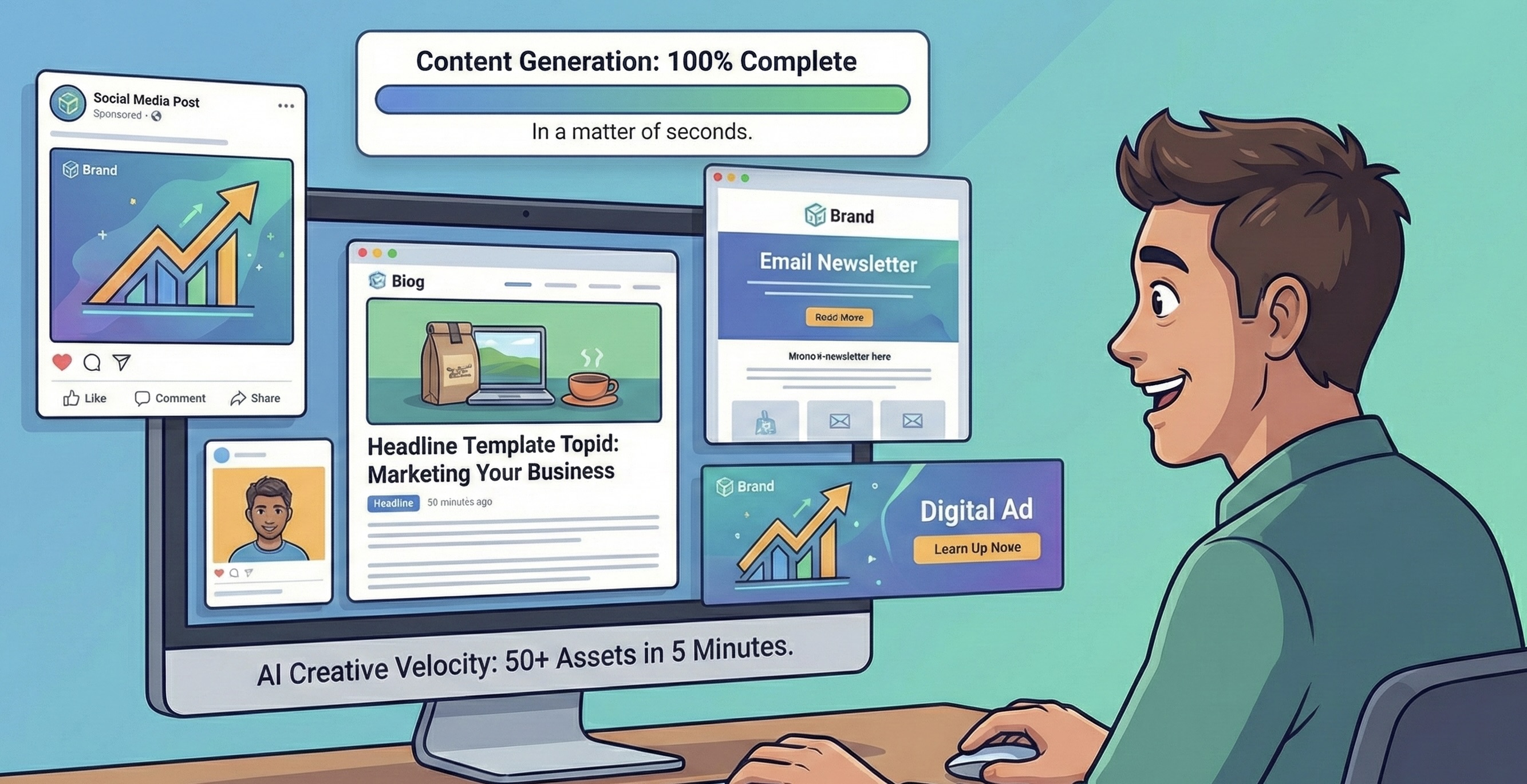
AI Content Velocity: Instead of hiring a copywriter, they used Jasper to turn their founder’s rough notes on "coffee sourcing" into 50 unique blog posts and 200 social media captions. They dominated niche search terms like "best organic light roast for cold brew"—terms the big giant ignored.
Predictive Audiences: They used Pecan AI (a low-code predictive tool) to analyze their existing customers. The AI found a pattern: their best customers weren't just "coffee lovers," they were specifically "remote workers who bought tech accessories."
Creative Automation: They used Midjourney to create whimsical, hyper-local ad images (e.g., a coffee cup sitting on a recognizable local landmark) for 50 different cities. A big brand would never spend resources customizing ads for small towns.
The Results (6 Months):
Organic Traffic: +300% (due to mass content creation).
Ad Relevance: Their local ads had a 4x higher Click-Through Rate (CTR) than generic big-brand ads.
CPA: Dropped by 60%.
Growth: They expanded from local delivery to national shipping, stealing thousands of customers who preferred the "personal" touch of a brand that seemed to know their city.
Key Takeaway: They didn't outspend the giant; they out-personalized them.
Key Takeaways: How to Win
If you are a small business owner, here is your cheat sheet for 2025:
Don't Compete on Noise, Compete on Nuance: You can't shout louder than big brands. But you can whisper the exact right message to the exact right person using AI segmentation.
Adopt "Centaur Marketing": The most successful teams aren't AI-only or Human-only. They are Centaurs—humans using AI to extend their capabilities. One marketer + ChatGPT = A team of three.
Speed is Your Weapon: When a new trend hits (like a viral audio on TikTok), use AI video tools to produce content that same day. Big brands take weeks to approve legalities; by then, the trend is dead.
Trust the Algorithms: Stop manually tweaking Facebook ad bids. The AI is smarter than you. Focus your energy on making better creative (images/videos), and let the AI handle the math.
Frequently Asked Questions (FAQs)
We know that diving into AI can feel overwhelming. Here are the most common questions small business owners ask us.
1. Will AI marketing replace my marketing team?
No. AI replaces tasks, not roles. It replaces the drudgery of resizing images, sorting data in Excel, and writing 50 variations of a headline. This frees up your human team to do what AI cannot: build relationships, think strategically, and be creative. A human using AI will replace a human who doesn't.
2. Is AI expensive for a small business?
Not anymore. Most robust AI marketing tools range from $20 to $100 per month. Even enterprise-grade tools like HubSpot have "Starter" tiers powered by AI. The ROI is often immediate because you save dozens of labor hours per week.
3. Do I need technical skills or coding knowledge?
Zero. The new wave of AI tools is "No-Code." If you can type a sentence into Google, you can use these tools. Platforms like Zapier allow you to connect apps using plain English (e.g., "When I get a new lead, send them an email").
4. Is my customer data safe with AI?
This is a valid concern. Reputable paid tools (like Jasper, Salesforce, Gemini Enterprise) do not train their public models on your private data. However, be careful with free versions of tools. Always check the "Data Privacy" settings and opt out of data training if you are handling sensitive customer info.
5. Won't AI-written content hurt my SEO?
Google has explicitly stated that they do not penalize AI content if it is high quality and helpful. The risk isn't that it's AI; the risk is that it's boring. You must edit AI content to add your unique brand voice, local expertise, and real-world examples (E-E-A-T). Unedited, robotic content will fail.
Is Your Marketing Strategy Ready for the AI Era?
Understanding that AI can help is the first step. Knowing how to implement it without wasting money is the second.
Many small businesses fall into the trap of buying too many tools and having no strategy. They end up with a "Frankenstein" system that costs money but generates no leads.
At Ads Kong, we specialize in cutting through the noise. We build lean, high-performance marketing engines that utilize the best AI technology to drive legitimate revenue—not just clicks. We help you compete with the giants, and win.
Stop Guessing. Start Scaling. Click here to visit our Homepage and see how we engineer growth.