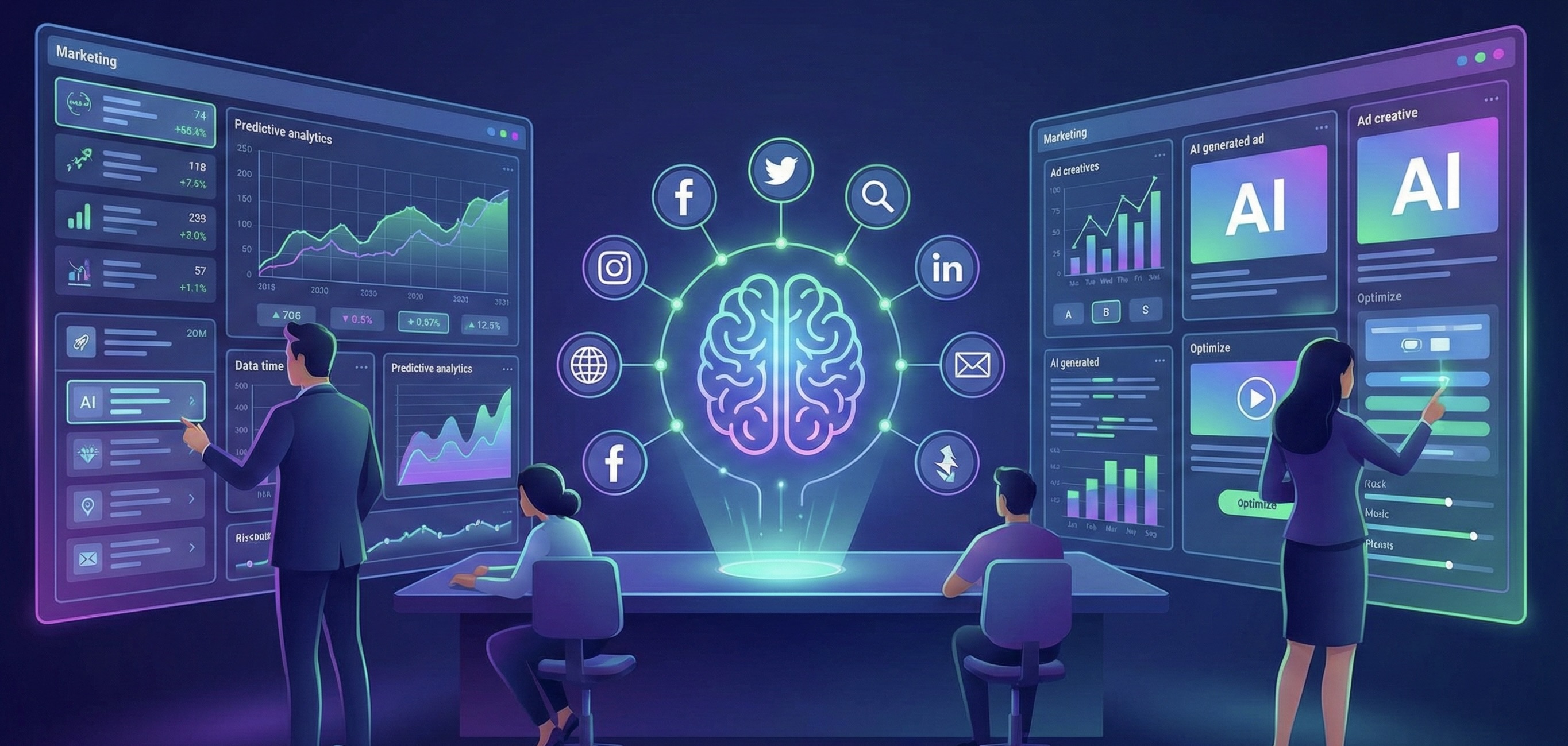
AI Tools Every Digital Marketing Agency Is Using in 2025: The Ultimate Guide to Scaling
The digital marketing landscape of 2025 is unrecognizable compared to just three years ago. The era of "testing and guessing" is over. Today, we live in the age of Predictive Marketing and Answer Engine Optimization (AEO).
For agencies and brands alike, Artificial Intelligence is no longer a "nice-to-have" add-on; it is the infrastructure upon which successful campaigns are built. Whether it’s automating bid strategies for Google Ads, generating hyper-personalized creative at scale, or predicting customer lifetime value (LTV) before a user even makes a purchase, AI is the silent partner in every top-tier agency.
In this comprehensive guide, we explore the essential AI tools that are defining success in 2025, how they are being used to crush CPA (Cost Per Acquisition) targets, and why "Agentic SEO" is the new frontier you cannot afford to ignore.
The Shift: From "Search" to "Answers" and "Agents"
Before diving into the tools, it is critical to understand the environment of 2025. The traditional "10 blue links" on Google have been replaced by AI Overviews and Zero-Click Searches. Users are no longer just searching; they are asking complex questions to AI agents like Gemini, ChatGPT, and Perplexity, expecting instant, synthesized answers.
For digital marketing agencies, this shifts the goalpost. Success isn't just about traffic; it's about being the cited authority in an AI’s answer. It’s about feeding the algorithms the right data to ensure your brand is the recommendation.
Category 1: AI for Paid Media & Performance Marketing (PPC)
In 2025, manual bidding will be obsolete. The agencies winning the market are those that master "AI-Management" – guiding the algorithms rather than fighting them.
1. Google Performance Max (PMax) & Nano Banana Pro
While Google’s native AI isn't a third-party tool, it is the elephant in the room. In 2025, Google’s Nano Banana Pro image model revolutionized ad creative, allowing advertisers to generate studio-quality visuals directly within the Ads interface.
Why Agencies Use It: It uses "Gemini 3" reasoning to understand real-world context, creating visuals that aren't just pretty, but commercially persuasive.
Key Feature: Multilingual text rendering in images, allowing global campaigns to scale without a massive design team.
2. RevealBot
For agencies managing high-spend accounts on Meta (Facebook/Instagram) and TikTok, RevealBot remains the gold standard for automation.
What It Does: It allows you to build complex "If/Then" rules that function 24/7. For example: "If ROAS drops below 2.0 for 3 consecutive hours, pause the ad and alert the Slack channel."
2025 Update: Its new predictive modeling can forecast ad fatigue, pausing creatives before their performance dips, saving thousands in wasted spend.
3. AdCreative.ai
Creative fatigue is the #1 killer of paid social campaigns. AdCreative.ai solves this by generating hundreds of conversion-focused ad creatives in seconds.
The AI Advantage: Unlike human designers who rely on intuition, this tool is trained on millions of high-converting ads. It knows exactly where to place the text, what button color drives clicks, and which image style stops the scroll.
Impact: Agencies report a 14x higher conversion rate when using data-backed creatives versus standard design.
4. Opteo
For Google Ads management, Opteo acts as a 24/7 analyst. It continuously monitors accounts for statistical significance, suggesting optimizations that a human might miss.
Best For: Managing budgets and ensuring no "zombie ads" (ads that spend money but don't convert) are left running.
Category 2: AI for SEO and Content (The "AEO" Revolution)
Ranking in 2025 requires a dual strategy: optimizing for humans and optimizing for Large Language Models (LLMs).
5. Surfer SEO (Evolution 4.0)
Surfer has evolved from a keyword tool to a full Topical Authority Engine. In 2025, it doesn't just tell you which keywords to use; it analyzes the "Information Gain" score required to rank.
Why It Matters: Google now prioritizes content that adds new value. Surfer analyzes the top 50 results to find gaps in information, ensuring your content isn't just a rehash of what’s already there.
6. Perplexity.ai (Brand Monitoring)
While technically a search engine, agencies use Perplexity as a listening tool.
Use Case: Agencies query Perplexity about their clients (e.g., "What is the best CRM for small business?") to see if their client is mentioned. If not, they know they need to improve their "Entity SEO" and brand citations on authoritative sites.
7. Jasper (Enterprise Edition)
Jasper has matured into a full Marketing Operating System. It’s no longer just writing blogs; it’s managing entire brand voices.
Brand Voice 2.0: Agencies upload a client’s CEO interviews, whitepapers, and emails. Jasper learns the exact tone and nuance, ensuring that every piece of content—from a LinkedIn post to a whitepaper—sounds exactly like the brand, not a robot.
8. Alli AI
For technical SEO, Alli AI is a game-changer. It allows agencies to make code-level changes (like altering meta tags, link structures, and schema markup) automatically across millions of pages without needing a developer.
The Benefit: It bypasses the bottleneck of waiting for a client’s dev team to approve changes, allowing for instant SEO deployment.
Category 3: AI for Data Analysis & CRM
Data is useless if you can't interpret it. AI tools in 2025 act as the bridge between raw data and strategic action.
9. HubSpot AI (Breeze)
HubSpot’s AI, Breeze, is now deeply integrated into the CRM. It offers "Predictive Lead Scoring" that is frighteningly accurate.
How It Works: It analyzes thousands of touchpoints—email opens, page views, time on site, social interactions—to predict which leads are ready to buy right now.
Agency Application: This allows agencies to send "Sales Qualified Leads" (SQLs) to clients with confidence, reducing friction between marketing and sales teams.
10. Zapier Central
Zapier has moved beyond simple automation to AI Agents. You can now teach a Zapier agent to perform complex tasks across multiple apps.
Example: "When a new lead comes in from Facebook Ads, research their company on LinkedIn, summarize their recent news, and draft a personalized email in Gmail for me to review."
Key Takeaways: The 2025 Agency Playbook
Creativity is the Variable: With AI handling bidding and targeting, the creative (images, videos, copy) is the biggest lever for success. Tools like AdCreative.ai and Nano Banana Pro are essential for keeping creative fresh.
AEO is the New SEO: You must optimize for "Answer Engines." Use tools like Surfer to ensure your content provides unique information gain that AI models want to cite.
Automation Rules: Never let a budget run unmonitored. Use RevealBot or Opteo to act as a 24/7 guard dog for your ad spend.
Transparency Wins: Clients in 2025 demand real-time insights. AI dashboards that integrate data from all sources (like HubSpot) are non-negotiable.
Creativity is the Variable: With AI handling bidding and targeting, the creative (images, videos, copy) is the biggest lever for success. Tools like AdCreative.ai and Nano Banana Pro are essential for keeping creative fresh.
AEO is the New SEO: You must optimize for "Answer Engines." Use tools like Surfer to ensure your content provides unique information gain that AI models want to cite.
Automation Rules: Never let a budget run unmonitored. Use RevealBot or Opteo to act as a 24/7 guard dog for your ad spend.
Transparency Wins: Clients in 2025 demand real-time insights. AI dashboards that integrate data from all sources (like HubSpot) are non-negotiable.
Case Study: Scaling a Fashion Brand with AI-Driven Performance
Note: This case study reflects the data-driven approach used at Ads Kong.
Client: "Velvet & Vine" (Premium Boutique Fashion) Challenge: The brand was stuck at a plateau. Their CPA (Cost Per Acquisition) was hovering at $45, which was unsustainable. Despite increasing budgets, sales volume wasn't growing—a classic case of "Ad Fatigue" and inefficient targeting.
The Strategy: The "AI-First" Restructure
Creative Overhaul with AI: We used generative AI tools to turn their static product photos into lifestyle scenes. Instead of a plain white background, products were visualized in "Parisian Streets" or "Cozy Autumn Lounges." This increased Click-Through Rate (CTR) by 150%.
Predictive Bidding: We moved the account to a structure that separated High-Margin SKUs from Low-Margin ones. We then fed first-party data (customer emails) into the ad platforms to create "Lookalike" audiences based on Lifetime Value, not just immediate purchase.
Automated Rules: We implemented strict rules using automation software. If a creative didn't hit a ROAS (Return on Ad Spend) of 2.5x within 48 hours, it was automatically killed, and a new AI-generated variation was rotated in.
The Results (90 Days Later):
ROAS: Increased to 400% (4x Return).
CPA: Dropped from $45 to $22.
Revenue: Monthly revenue increased by 150%.
By removing emotional decision-making and relying on AI-driven data and creative velocity, the brand broke through its ceiling.
Stop Burning Budget on Outdated Strategies
Are you still relying on manual bidding and "gut feeling" marketing? In 2025, that is the fastest way to drain your budget.
At Ads Kong, we don't just "run ads"—we engineer profit. We act as an extension of your team, utilizing the advanced AI tools mentioned above to ensure every dollar you spend brings a return. Whether you need to fix a leaking funnel, scale your e-commerce revenue, or dominate local SEO, our data-backed approach guarantees transparency and results.
Click here to Book Your Free Deep-Dive Audit at AdsKong.com and let’s build a roadmap to predictable growth for your business.
Conclusion
The tools listed above are powerful, but they are just instruments. The magic lies in how they are played. The best digital marketing agencies in 2025 are those that combine the raw processing power of AI with the strategic empathy of human marketers.
As we move toward 2026, the gap between "AI-native" agencies and traditional ones will widen. The winners will be those who use AI to free up time for what truly matters: strategy, creative storytelling, and building real relationships with customers.
Ready to future-proof your marketing? Start by auditing your current stack and asking: "Is this tool helping me predict the future, or just reporting on the past?"