In the old days of Google Ads (circa 2022), A/B testing was simple.
You wrote two Expanded Text Ads (ETAs), flipped a coin, and waited to see which one got more clicks.
In 2026, that method is dead.
With the dominance of Responsive Search Ads (RSAs), Performance Max (PMax), and AI Max campaigns, the concept of a single “ad” no longer exists.
Today, an ad is:
-
A fluid, AI-assembled combination of
-
15 headlines
-
4 descriptions
-
Dynamic images & videos
Google now tests thousands of creative combinations per day automatically.
So does this mean A/B testing is over?
👉 Absolutely not.
It means testing has evolved from tactical to strategic.
If you aren’t actively running creative experiments in 2026, you’re not optimizing —
you’re just letting Google spend your money on its own terms.
This guide breaks down A/B testing strategies that actually move revenue, with real-world examples you can replicate today.
The “CTR Trap”: Read This Before Testing Anything
Before we dive in, we need to address the biggest mistake advertisers make.
High CTR is vanity. High conversion rate is sanity.
An ad promising “Free iPhones” for a plumbing service might get a 50% CTR —
but a 0% conversion rate.
🎯 The Real Goal of A/B Testing in 2026
To identify the creative that attracts high-quality buyers, not curiosity clicks.
Your job is to train the AI to find customers, not browsers.
Experiment 1: Control vs. Chaos (RSA Pinning Test)
The Concept
Google prefers unpinned RSAs because they give the algorithm maximum freedom.
But that freedom often creates nonsensical ads.
This test checks whether human logic beats algorithmic randomness.
The Setup
-
Ad A (The Robot):
-
15 headlines, 4 descriptions
-
Nothing pinned
-
-
Ad B (The Human):
-
Same assets
-
Headline 1 pinned to the hook
-
Headline 2 pinned to the value proposition
-
Real-World Example (B2B SaaS – CRM)
Unpinned RSA (Ad A):
Top Rated CRM | Start Free Trial | Easy Integration
Pinned RSA (Ad B):
-
H1 (Pinned): Stop Losing Leads to Messy Spreadsheets
-
H2 (Pinned): The #1 CRM for Small Teams
-
H3: AI-selected CTA
Why This Works
Pinned ads often show:
-
Slightly lower CTR
-
20–30% higher conversion rate
Coherent messaging beats random combinations when purchase intent matters.
Experiment 2: Pain vs. Gain Headline Test
The Concept
Humans are twice as motivated to avoid pain as they are to seek pleasure.
This test compares fear-based vs benefit-based messaging using Ad Variations.
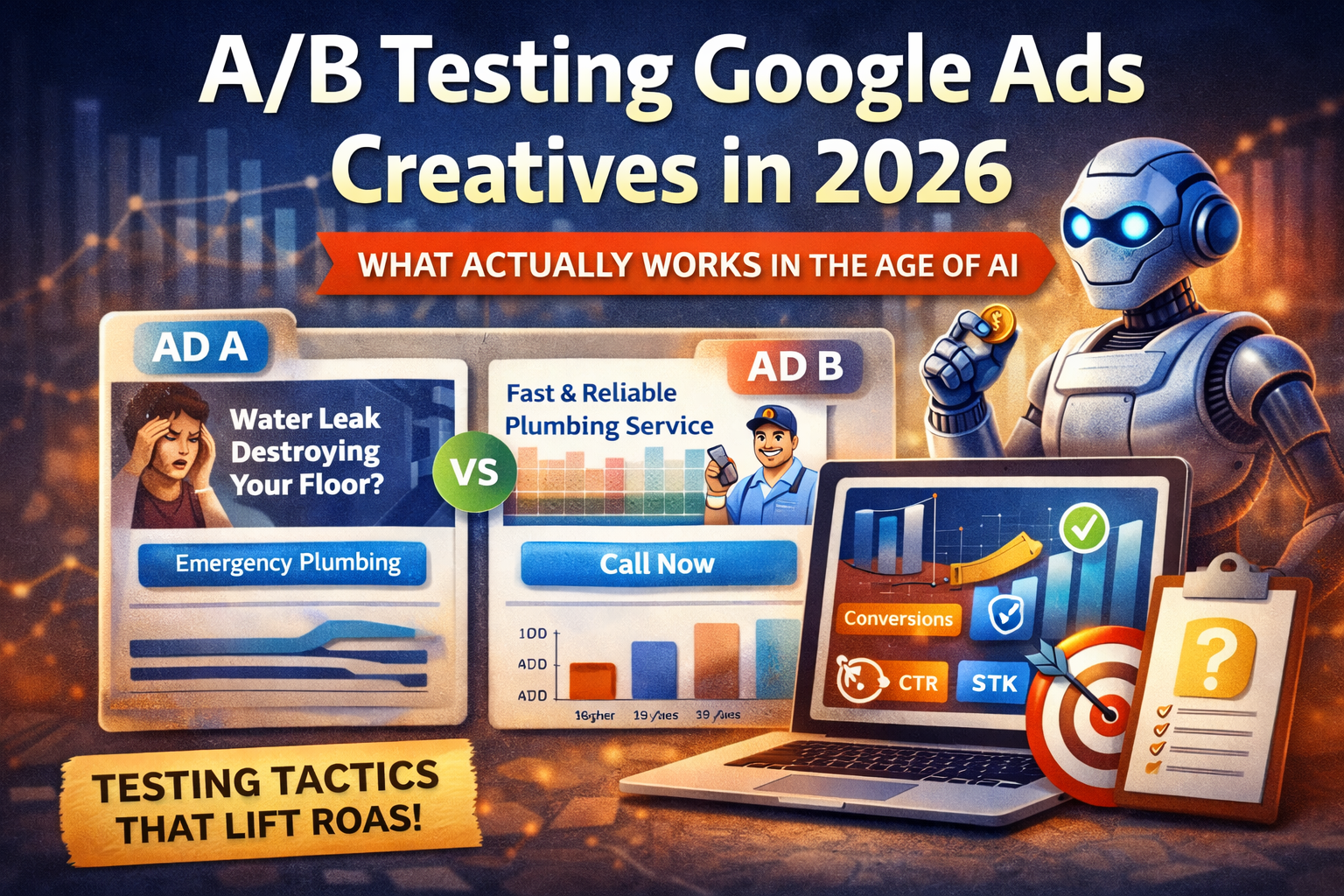
Real-World Example (Emergency Plumber)
Variation A – Gain Focused
-
Fast & Reliable Plumbing Services
-
24/7 support. 5-star rated technicians.
Variation B – Pain Focused
-
Water Leak Destroying Your Floor?
-
We arrive in 60 minutes to stop the damage.
Insight
-
Emergency services → Pain messaging wins
-
Luxury brands → Gain messaging often wins
Always test — psychology varies by intent.
Experiment 3: Performance Max Asset Groups (Lifestyle vs Product)
The Concept
In late 2025, Google finally enabled asset-level testing inside PMax.
This allows true creative A/B testing inside the black box.
The Setup
Create two Asset Groups within the same PMax campaign (or via PMax Experiments).
Real-World Example (E-commerce – Running Shoes)
Asset Group A: Product-Focused
-
White background product images
-
Auto-generated slideshow
-
Specs-driven copy
Asset Group B: Lifestyle / UGC
-
Real runners in action
-
Vertical iPhone video (9:16)
-
Emotion-driven copy (“Crush your PB”)
2026 Insight
With YouTube Shorts inventory exploding:
-
UGC-style creatives
-
Vertical video
-
Authentic, imperfect visuals
👉 These consistently outperform polished studio assets.
Experiment 4: CTA Testing (Hard Ask vs Soft Ask)
The Concept
Are you proposing marriage on the first date?
High-ticket services often perform better with low-commitment CTAs.
Real-World Example (Solar Installation)
Hard CTA
-
Buy Solar Panels Today
-
CTA: Get Quote
Soft CTA
-
See If Your Roof Qualifies for Solar
-
CTA: Check Eligibility
Result
“Check Eligibility” lowers psychological resistance and increases CTR —
as long as the landing page matches the promise.
Experiment 5: Landing Page Message Match
The Concept
Ads don’t fail — mismatched landing pages do.
Real-World Example (Digital Marketing Agency)
Ad Headline:
ROI-Focused Google Ads Management
Landing Page A: Generic homepage (SEO, Social, Web, PPC)
Landing Page B: Dedicated Google Ads page
-
H1: We Obsess Over Your Google Ads ROI
Why It Matters
Better message match =
-
Higher Quality Score
-
Lower CPC
-
Higher conversion rate
Landing Page B almost always wins.
How to Run These Tests Correctly
For Search Ads (Copy Testing)
-
Campaigns → Experiments → Ad Variations
-
Use Find & Replace or Text Update
-
Run until 95% statistical significance
For Bidding & Landing Pages
-
Campaigns → Experiments → Custom Experiments
-
Split traffic 50/50
-
Ideal for bid strategies or URL testing
For Performance Max
-
Use Performance Max Experiments
-
Test:
Final URL expansion
Asset groups
PMax vs Search uplift
AI Max & the Future of Testing
AI Max dynamically rewrites copy based on user intent.
-
“Cheap” → Budget-friendly
-
“Best” → Premium quality
You cannot test every variation.
Your Role in 2026:
Test themes, psychology, and angles, not individual words.
Feed AI the right intent — let it handle execution.
Final Checklist for A/B Testing Success
✅ Test one variable at a time
✅ Allow 7–14 days learning phase
✅ Run tests for 4–6 weeks
✅ Optimize for conversion rate & revenue, not CTR
If you need expert guidance or a free audit of your Google Ads and Meta Ads account—including AI Max and Performance Max optimization—get in touch with us and book your free audit.