Why CRO Is the Highest-Leverage Investment You Can Make in Your E-Commerce Business
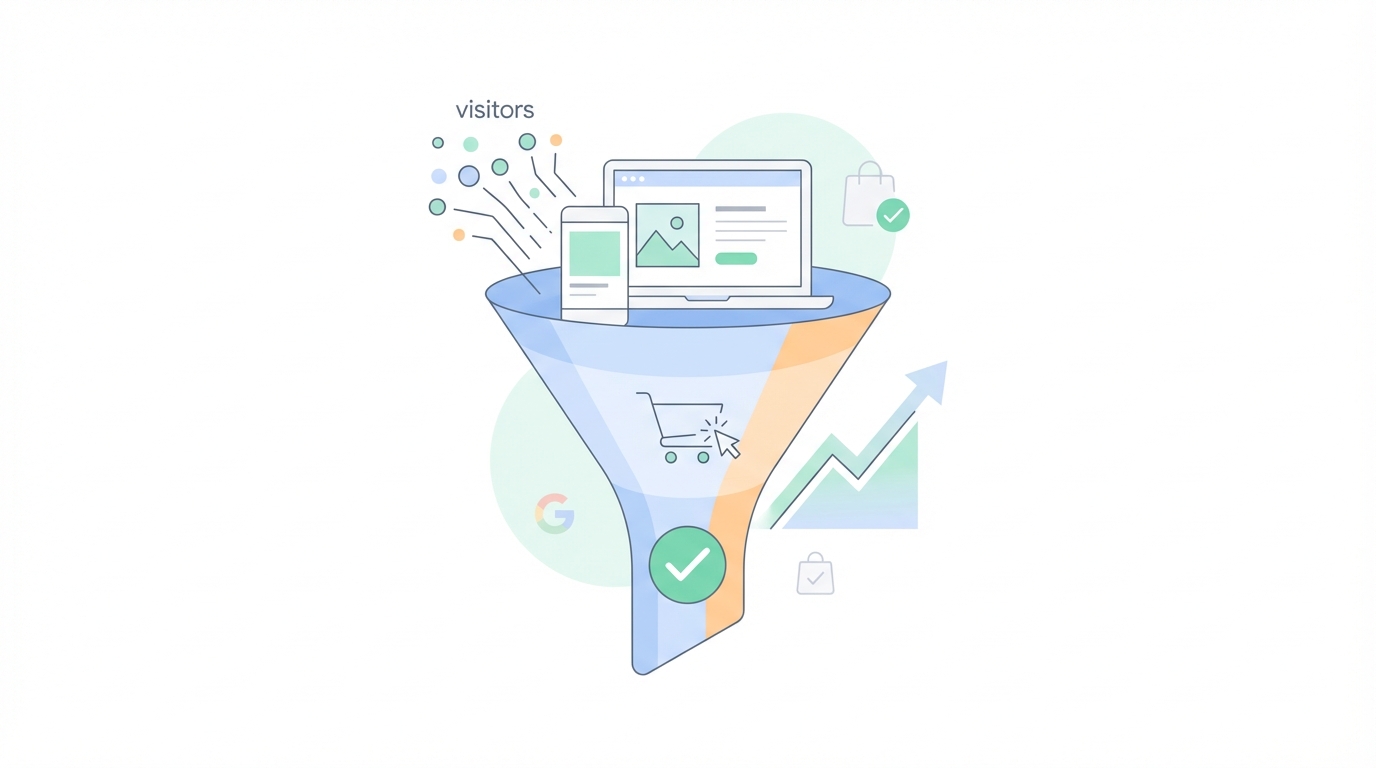
Most e-commerce businesses are so focused on driving more traffic that they never stop to ask: "What happens to all the traffic I already have?" The average e-commerce conversion rate globally sits between 1.5–3%. That means for every 100 visitors who land on a typical online store, 97 or more leave without buying. This is not a traffic problem — it is a conversion problem.
Conversion Rate Optimisation (CRO) is the systematic process of increasing the percentage of visitors who complete a desired action on your website — typically a purchase. Unlike paid traffic, which requires continuous spend, CRO improvements compound over time and make every rupee you spend on ads, SEO, and social media more profitable. Doubling your conversion rate from 1.5% to 3% effectively halves your customer acquisition cost and doubles your revenue from the same traffic. This guide covers the 12 most impactful CRO tactics for e-commerce stores in 2026.
Tactic 1: Speed Up Your Website — Especially on Mobile
Website speed is the foundational conversion lever. According to Google, a 1-second delay in mobile page load time can reduce conversions by up to 20%. In India, where a significant portion of e-commerce traffic comes from mobile devices on 4G networks, page speed is particularly critical.
Use Google's PageSpeed Insights to get a score for both mobile and desktop. Focus on these improvements first: compress all images using a tool like Squoosh or TinyPNG, enable lazy loading for below-the-fold images, minify CSS and JavaScript files, use a Content Delivery Network (CDN) to serve assets from servers closer to your users, and upgrade to faster hosting if needed. Every 100ms improvement in load time has a measurable impact on your conversion rate.
Tactic 2: Redesign Your Product Pages for Conversion
Your product page is where the decision to buy is made or abandoned. A high-converting product page in 2026 includes:
- Multiple high-resolution images from different angles. Include a lifestyle image showing the product in use, a scale reference image, and a detail/close-up shot. Zoom functionality is essential.
- A short, benefit-focused product title that clearly communicates what the product is and who it is for
- Social proof immediately below the title. Show your star rating and review count prominently — this is often the first thing shoppers look for
- A clear, prominent CTA button ("Add to Cart" or "Buy Now") that is visible above the fold on mobile without scrolling
- Scarcity and urgency signals where genuine: "Only 3 left in stock" or "Order within 2 hours for next-day delivery"
- Shipping information and delivery estimate above the CTA — delivery speed is often a final deciding factor
- Product video. Pages with product video convert at 80% higher rates than those without, according to multiple industry studies
Tactic 3: Simplify Your Checkout Process
Cart abandonment rates average 70% globally, and a complicated checkout process is the #1 cause. Every additional step, form field, or decision in your checkout funnel bleeds conversions. Optimise your checkout by:
- Offering a guest checkout option — never force account creation before purchase
- Reducing checkout to a maximum of 2–3 steps or using a single-page checkout layout
- Displaying a progress indicator so shoppers know how many steps remain
- Pre-filling address fields using the customer's pincode/postcode lookup
- Offering multiple payment options including UPI, debit/credit cards, net banking, EMI options, and wallets like Paytm and Google Pay for Indian customers
- Displaying the total order cost including shipping, taxes, and fees from the cart page — surprise charges at checkout are the single biggest cause of abandonment
Tactic 4: Add Strategic Social Proof Throughout Your Site
Social proof is one of the most powerful psychological conversion drivers. When potential buyers see that others have purchased and been satisfied, their purchase anxiety decreases dramatically. Layer social proof at every stage of the buying journey:
- Homepage: Total customers served, aggregate review score, media mentions, trusted brand logos
- Product pages: Star rating, review count, number of purchases ("2,847 sold"), customer photos in reviews
- Cart page: "Join 10,000+ happy customers" or recent purchases ("Priya from Mumbai just ordered this 5 minutes ago")
- Checkout page: Security badges, money-back guarantee, payment security icons
Reviews with photos convert at 5x higher rates than text-only reviews. Add a photo review request to your post-purchase email flow using tools like Loox, Yotpo, or Judge.me.
Tactic 5: Implement a Cart Abandonment Recovery Strategy
Cart abandonment represents your hottest lost leads — people who wanted to buy but did not complete their purchase. A three-part recovery strategy can recapture 15–30% of these abandoned carts:
- Email 1 (1 hour after abandonment): A gentle reminder with the exact items left in the cart. No discount — they may buy at full price.
- Email 2 (24 hours after abandonment): Address common objections. Include customer reviews, your return policy, and delivery information. This is where you answer "Why should I trust you?"
- Email 3 (72 hours after abandonment): If they still have not purchased, offer a time-limited incentive (5–10% off, free shipping, or a free gift) to close the sale.
Add SMS and WhatsApp recovery messages to your sequence for Indian customers — these channels have significantly higher open rates than email.
Tactic 6: Build Trust with a Clear, Generous Return Policy
Purchase anxiety — the fear of making a wrong decision — is one of the primary reasons visitors do not convert. A clear, prominent, and generous return policy removes this anxiety. Display your return policy everywhere: on product pages, in the cart, at checkout, and in confirmation emails. If you offer free returns, make this a headline message. Research consistently shows that generous return policies increase conversion rates and net revenue — reduced purchase anxiety leads to more purchases, and return rates rarely offset the revenue gain.
Tactic 7: Use Exit-Intent Popups Strategically
Exit-intent popups detect when a visitor is about to leave your site (by moving their cursor toward the browser's back button or close button) and display a targeted offer. When done well, they can recover 5–15% of otherwise lost visitors. Key principles:
- Show the popup only once per session — repeated popups are deeply annoying and increase bounce rate
- Offer genuine value: a discount code, free shipping threshold unlock, or a lead magnet (like a buying guide)
- Make the close button obvious — making it hard to close a popup destroys trust
- A/B test your offer, headline, and CTA copy to find the best-performing combination
Tactic 8: Optimise Your Site Search
Visitors who use your site search have extremely high purchase intent — they are looking for something specific. Yet most e-commerce stores have terrible site search that returns irrelevant results, has no typo tolerance, and shows no filters. Customers who use site search convert at 2–3x higher rates than those who browse. Invest in a quality search solution. At minimum, ensure your search handles common misspellings, shows product images in results, and allows filtering by price, category, and other attributes. Tools like Searchanise, Boost Commerce, or Klevu offer significant upgrades over default Shopify/WooCommerce search.
Tactic 9: Personalise the Shopping Experience
Personalisation — showing visitors products and offers based on their browsing history, purchase history, and preferences — is one of the highest-impact CRO levers available to e-commerce brands. Basic personalisation includes:
- "Recently Viewed" product blocks on homepage, category pages, and cart page
- "Customers Also Bought" and "You May Also Like" recommendations on product pages
- Returning customer welcome back messages with their name and recently viewed items
- Dynamic homepage banners that show category-specific offers based on browsing history
Tools like Klaviyo (email personalisation), LimeSpot, and Recommendation AI (Google Cloud) make personalisation accessible even for small to mid-size stores.
Tactic 10: A/B Test Everything — But Test One Thing at a Time
CRO is a scientific process. Gut feelings about what will "work" are frequently wrong. The only reliable way to know what improves conversion is to test it with real traffic. Use tools like Google Optimize (now Optimize 360), VWO, or Optimizely to run A/B tests on:
- CTA button colour, copy, and placement
- Product page headline and subheadline
- Hero image and video on homepage
- Pricing display (crossed-out RRP vs. percentage saving vs. rupee saving)
- Shipping threshold messaging ("Add ₹299 to get free shipping" vs. "Free shipping on orders over ₹499")
The key rule: test one variable at a time. If you change five things simultaneously, you cannot know which change drove the result. Run each test for at least 2 weeks or until you have 100+ conversions per variant before declaring a winner.
Tactic 11: Implement Live Chat and AI Chatbot Support
Purchase hesitation often comes from unanswered questions — "Will this fit me?", "What is the delivery time to Hyderabad?", "Is this compatible with my device?". Live chat and AI chatbots that can answer these questions in real time can increase conversion rates by 10–30%, particularly for high-ticket items. WhatsApp Business integration is particularly effective for Indian e-commerce customers — many are more comfortable asking questions via WhatsApp than via on-site chat. Ensure your chat widget is prominently visible on product pages and the checkout flow.
Tactic 12: Optimise for Mobile-First UX
In India, over 70% of e-commerce traffic comes from mobile devices. Despite this, most e-commerce stores are still designed desktop-first and adapted for mobile as an afterthought. A true mobile-first CRO approach means:
- Thumb-friendly navigation with a sticky bottom navigation bar for key sections
- Large, easy-to-tap CTA buttons (minimum 44px touch target)
- Single-column product grids optimised for vertical scrolling
- Simplified checkout with autofill, biometric payment (Face ID / fingerprint), and UPI deep links
- Sticky "Add to Cart" button that follows the user as they scroll down a product page
- Minimal popups and interstitials that block content on mobile
Conclusion: Every 1% Improvement Compounds
CRO is not a one-time project — it is a continuous process of testing, learning, and improving. The brands that systematically work through these 12 tactics and build a culture of data-driven experimentation see their conversion rates improve from an average of 1.5–2% to 4–6%, dramatically changing the economics of their ad spend and SEO investment.
At Ads Kong, we combine performance marketing expertise with CRO analysis to build complete growth systems for e-commerce brands. If you want us to audit your store's conversion funnel and identify the highest-impact opportunities specific to your business, book a free strategy call with our team today.